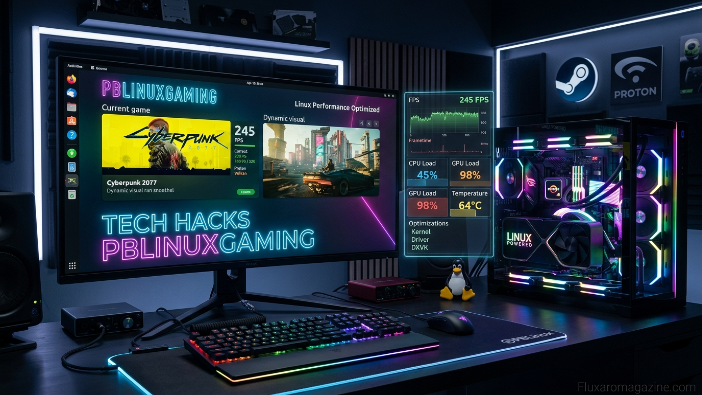
Gaming on Linux has evolved far beyond its early days as a niche alternative to Windows and consoles. With the rise of powerful open-source tools, compatibility layers, and system optimizations, Linux has become a serious contender for high-performance gaming. Among these developments, Tech Hacks PBLinuxGaming has emerged as a term representing a set of advanced strategies and tweaks that maximize Linux gaming performance. From improving FPS to reducing latency, these techniques help players leverage every bit of hardware power, while also optimizing the underlying operating system for stability and responsiveness.
PBLinuxGaming stands for Performance-Based Linux Gaming, a philosophy embraced by Linux enthusiasts who are committed to optimizing every aspect of their system for gaming. Unlike Windows, Linux does not automatically configure the system for gaming, which makes manual tweaks, driver adjustments, and performance monitoring essential. By using tools such as Proton, Wine, GameMode, and performance overlays like MangoHud, Linux gamers can create a highly optimized environment. These hacks not only enhance gameplay but also improve hardware utilization, allowing even mid-range systems to deliver impressive performance.
Understanding PBLinuxGaming and Its Importance
PBLinuxGaming is not a single software solution but rather a collective approach that emphasizes customization, optimization, and strategic configuration of Linux for gaming purposes. The concept revolves around understanding both the hardware and software layers of Linux and implementing tweaks that reduce overhead, improve rendering performance, and enhance compatibility with Windows-centric games. This approach is particularly valuable for competitive gamers or those running demanding AAA titles, where performance gains can be noticeable.
Linux has historically faced challenges with gaming due to driver inconsistencies and lack of native support for many popular titles. However, advancements in graphics APIs like Vulkan and the development of robust compatibility layers such as Proton and Wine have transformed the landscape. These tools translate Windows-based DirectX instructions into Linux-compatible commands, often improving performance and stability beyond what might be possible on Windows alone. Optimizing these layers requires careful attention to kernel parameters, CPU and GPU management, and process prioritization.
Key Tools for Linux Gaming Optimization
Several essential tools define the ecosystem of PBLinuxGaming. Proton, developed by Valve, allows thousands of Windows games to run seamlessly on Linux by translating DirectX calls to Vulkan and implementing specific game fixes. For non-Steam titles or older games, Wine serves as a compatibility layer that translates Windows system calls into Linux-compatible actions. Combined with Lutris, a management platform for running games with multiple engines, these tools provide a flexible foundation for running virtually any game on Linux.
Beyond compatibility, performance optimization is achieved through utilities like GameMode, which dynamically adjusts CPU governors, prioritizes game processes, and suppresses background tasks. MangoHud provides real-time monitoring of FPS, CPU and GPU utilization, temperatures, and frame timings, allowing gamers to identify bottlenecks and adjust settings accordingly. Advanced users may also employ low-latency kernels and GPU tuning to reduce scheduling delays and prevent throttling, which can significantly impact gameplay responsiveness.
Maximizing FPS and System Responsiveness
A major goal of Tech Hacks PBLinuxGaming is to improve frame rates and reduce latency, ensuring smooth gameplay. Updating GPU drivers to the latest versions is often the first step, as modern drivers include performance improvements and bug fixes essential for high-demand games. On Linux, official NVIDIA, AMD, and Intel drivers can be installed alongside open-source alternatives, though proprietary drivers generally offer superior gaming performance.
Enabling Vulkan support in games that allow it is another crucial optimization. Vulkan provides low-overhead access to GPU resources and enables better CPU-GPU synchronization, resulting in higher FPS and smoother frame delivery. Tools like GameMode further enhance responsiveness by optimizing CPU and I/O operations specifically for gaming sessions. For example, switching the CPU governor to “performance” during gameplay ensures that the processor maintains higher clock speeds, reducing stutter and input lag.
Advanced users can go even further by fine-tuning system settings. Adjusting swap usage, precompiling shader caches, and managing GPU power profiles are techniques that reduce stutters, load times, and frame inconsistencies. These adjustments, combined with careful monitoring of system resources via MangoHud, can transform a standard Linux installation into a finely tuned gaming machine.
Compatibility Hacks for Running Windows Games
One of the central challenges of Linux gaming is running titles that were designed exclusively for Windows. Here, compatibility layers play a vital role. Proton enables seamless execution of most Windows games on Steam, while Wine and Proton GE (a community-enhanced version of Proton) expand the playable library to include non-Steam titles and older games. Each layer includes game-specific patches that improve stability, fix graphical glitches, and sometimes boost performance beyond Windows equivalents.
By configuring each game individually, Linux users can achieve near-native performance levels. Adjusting runtime libraries, graphics API selection, and memory management ensures that games interact optimally with the Linux system. This approach allows gamers to maintain consistent FPS, reduce micro-stuttering, and enjoy a reliable gaming experience across a wide array of titles.
Advanced System-Level Optimizations
After applying basic tweaks, deeper system-level optimizations provide additional performance gains. Installing a low-latency or real-time kernel reduces scheduling delays, making the system more responsive to gaming inputs. This is particularly beneficial for competitive multiplayer games, where millisecond differences can determine outcomes. Tweaking CPU affinity, I/O scheduling, and memory allocation allows Linux to prioritize game-related processes while reducing background interruptions.
Memory management is another critical factor. By optimizing swap behavior and reducing unnecessary background services, active game data stays in RAM longer, reducing load times and eliminating occasional stutters. Precompiling shaders for Vulkan or DXVK games also prevents runtime compilation freezes, providing a smooth experience from the first frame to the last. Network optimization techniques, such as adjusting DNS settings or prioritizing gaming traffic, further enhance online gameplay performance.
Common Challenges and How to Overcome Them
While PBLinuxGaming unlocks significant performance advantages, Linux gamers face unique challenges. One recurring issue is anti-cheat compatibility. Many popular multiplayer games rely on Windows-centric anti-cheat systems that may not function correctly on Linux, preventing game access. Understanding these limitations and using community-provided patches or alternative anti-cheat solutions is essential.
The learning curve is another challenge. Many optimizations require knowledge of terminal commands, system configuration, and driver management. However, the Linux gaming community provides extensive documentation, tutorials, and forums where players share proven techniques. Realistic expectations are also important: while system tweaks can significantly improve FPS and responsiveness, some titles may show limited gains due to inherent design constraints.
The Role of Community and Continuous Learning
PBLinuxGaming thrives on community collaboration. Gamers contribute detailed guides, performance benchmarks, and compatibility reports that help others optimize their systems. Platforms like GitHub, Reddit, and Discord serve as hubs for sharing configuration scripts, kernel patches, and Proton builds. Staying updated with these resources ensures that Linux gamers can continually refine their setups and adapt to new hardware and software changes.
Moreover, continuous learning is vital. As Linux distributions, GPU drivers, and gaming APIs evolve, techniques that worked a year ago may require adjustments. Following community updates, experimenting with settings, and using monitoring tools like MangoHud allow players to adapt quickly. This culture of experimentation and shared knowledge is what makes PBLinuxGaming not just a collection of hacks, but a sustainable approach to high-performance gaming.
Read More : Tech Hacks PBLinuxGaming | Ultimate Linux Gaming Optimization
Future of Linux Gaming Optimization
Looking ahead, Linux gaming is poised for even greater achievements. Improvements in Vulkan, enhanced driver support from NVIDIA, AMD, and Intel, and the growing adoption of Proton and Wine make the platform more robust than ever. As more developers recognize Linux as a viable gaming environment, official optimization tools and native support for titles are likely to increase, reducing the need for complex manual hacks.
Tech hacks in the PBLinuxGaming ecosystem will continue to evolve alongside hardware innovations and gaming technologies. Gamers can expect smoother performance, better compatibility, and more intuitive tools that simplify system optimization. For enthusiasts willing to learn and experiment, Linux gaming offers not only performance benefits but also a level of control and customization unmatched by other platforms.
Conclusion
Tech Hacks PBLinuxGaming represents a comprehensive approach to maximizing Linux gaming performance. By combining compatibility layers like Proton and Wine with performance tools such as GameMode, MangoHud, and kernel optimizations, Linux gamers can achieve FPS, responsiveness, and stability that rival or even surpass traditional platforms. While challenges such as anti-cheat compatibility and manual configuration remain, the Linux gaming community’s collective knowledge ensures that these obstacles can be navigated successfully. For players seeking flexibility, control, and high-performance gaming, embracing PBLinuxGaming is not only practical but essential in 2026 and beyond.