Introduction: Understanding the DK380C4.0‑H8 Model Size
The term DK380C4.0‑H8 model size might seem technical at first glance, yet it represents a real and practical specification within industrial automation, machine components, and engineered systems. In manufacturing and control systems, product model identifiers like “DK380C4.0‑H8” are used to convey power ratings, physical dimensions, configuration revisions, and versioned capabilities in a format that professionals can immediately recognize. For engineers, procurement teams, and technical planners, understanding the model size of equipment like the DK380C4.0‑H8 is essential for deciding compatibility, installation planning, and performance expectations. The physical size of such components directly influences decisions ranging from workspace layout and cooling considerations to safety clearances and maintenance protocols.
Physical measurements and model naming conventions seem straightforward but actually encapsulate layers of technical meaning. “DK380C4.0‑H8” itself is not just a label — it conveys a family of specifications that affect everything from how the system is mounted to how it communicates with other machinery. Because this type of model designation is common in industrial environments, those tasked with development, operations, or system integration benefit tremendously from a clear, structured understanding of what each part of the model name implies, how size and power interact, and why thoughtful planning around these details produces long‑term value. In this article, we will explore the DK380C4.0‑H8 model size from multiple angles, explaining the components of the name, the physical dimension impacts, installation considerations, performance relevance, and real‑world application scenarios.
The Anatomy of the DK380C4.0‑H8 Identifier
To fully grasp what DK380C4.0‑H8 model size means, it helps to break the identifier into parts. In technical naming conventions, each segment typically reveals a specific attribute. The prefix “DK380” denotes the base series or class of the device. This might reference a family of controllers, drives, or motor systems that share core design attributes. In contrast to generic labels, a base series identifies an engineered product line with shared architecture. Professionals recognize “380” could imply compatibility with a three‑phase 380V electrical infrastructure, making it suited for industrial facilities where that voltage standard is prevalent.
The middle portion, “C4.0,” suggests a versioning or capacity rating. Industrial model conventionally uses “C” to signify a configuration or generation tier, while “4.0” is often interpreted as a performance marker or version indicator. For instance, “4.0” might reflect a 4.0‑kW power rating, a firmware revision level, or even a generation step in a hardware evolution. When considered alongside the base series name, this part helps users differentiate between functional variants, allowing precise selection based on required power and capability.
The final segment, “H8,” completes the model descriptor by pointing to a specific hardware variant or optional configuration. This could include enhanced cooling, specialized connectors, built‑in monitoring capabilities, or sealed housings tailored for harsher environments. The “H” often suggests a higher tier or advanced hardware option, while the number can represent a sequence or hardware revision within that tier. Understanding each segment of “DK380C4.0‑H8” establishes the foundation for interpreting both its physical size and functional implications in real installations.
Physical Dimensions and What They Mean in Practice
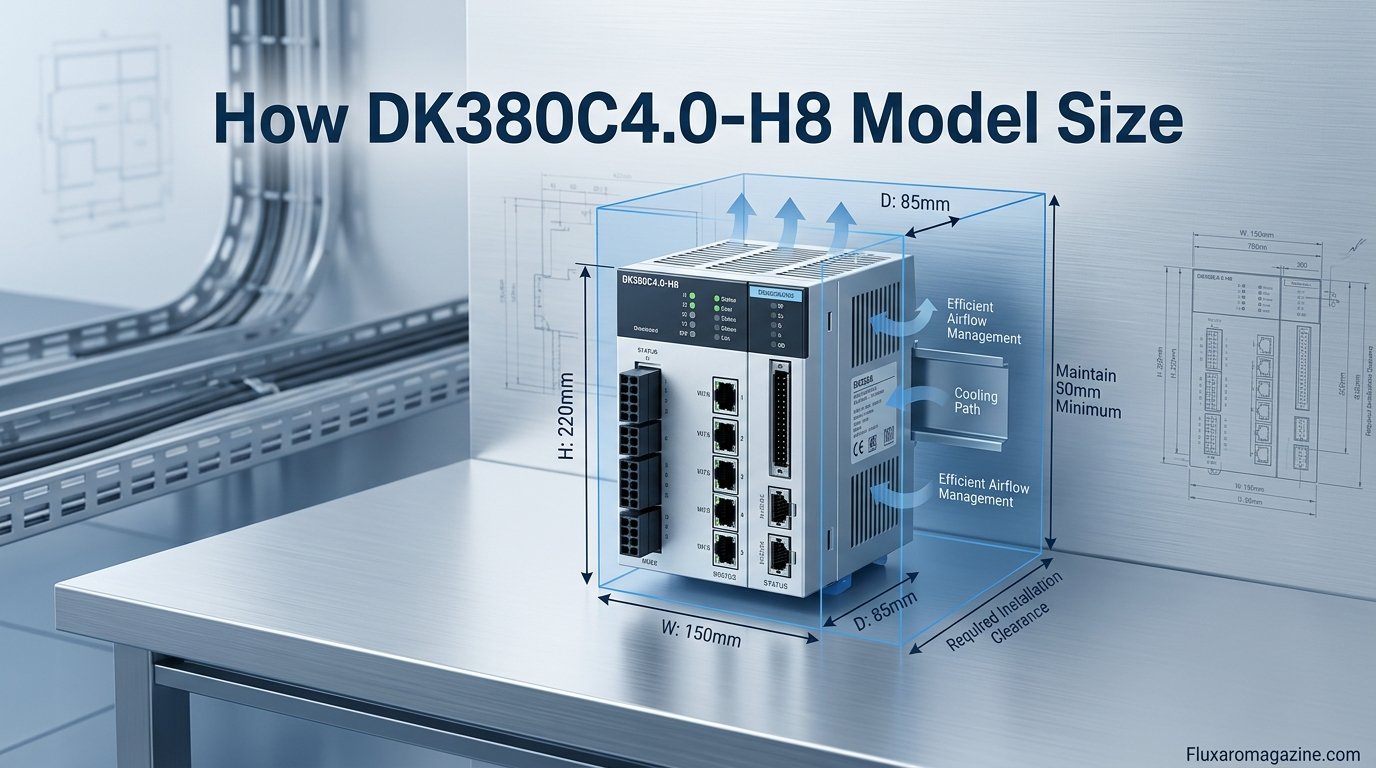
When designers and engineers talk about DK380C4.0‑H8 model size, they focus on the physical dimensions that determine how the unit fits into space. The physical size of a controller or drive unit like the DK380C4.0‑H8 is a practical concern for multiple reasons. Mounting cabinets, machine frames, and control panels all have finite available space, and incorrect estimation of size can lead to installation delays, retrofit headaches, or even structural modifications. Accurate model size information — width, height, and depth — ensures that the unit fits where intended with appropriate clearances for airflow, cabling, and servicing.
Although exact measurements can vary slightly between manufacturers or revisions, a typical DK380C4.0‑H8 unit is engineered with a compact footprint that balances power density and space efficiency. In many cases, size specifications cluster around dimensions that allow installation within a standard industrial control cabinet section without requiring bespoke fabrication. Designers prioritize minimizing depth to maintain cabinet accessibility, while ensuring height and width accommodate internal components like heatsinks, circuit boards, and terminal blocks.
Understanding how the unit’s size interfaces with its environment extends beyond the raw numbers. For example, positioning the unit to allow front access for operator panels or service is just as important as fitting within the cabinet. Equally, adequate clearance at the rear and sides is needed for heat dissipation — without which performance and long‑term reliability suffer. Engineers evaluate model size as part of a comprehensive spatial plan that encompasses both installation constraints and operational demands.
Weight and Its Role in Installation and Safety
Alongside physical dimensions, the weight of the DK380C4.0‑H8 model size plays a central role in planning. Industrial units of this nature often contain robust metal housings, heat‑dissipating structures, control boards, and power electronics, all of which contribute to mass that must be accounted for. A unit that is overlooked in weight considerations can pose challenges for mounting structures, rack supports, and even personnel safety during installation.
Accurate weight information helps teams design support brackets, anchor points, and shelving within control cabinets so that these structures are stable and compliant with safety regulations. When a unit is heavy, installation may require mechanical lifting aids, additional personnel, or dedicated fixtures to prevent strain injuries. Preparing for weight in advance helps reduce downtime and strengthens workplace safety culture.
Weight also interplays with model size expectations. A relatively compact unit can feel deceptively heavy if constructed with dense components or shielding. Conversely, a large but lightweight unit may suggest a different internal design focus on modularity or airflow optimization. Recognizing this interplay helps installers assess not just where the unit will go, but how it will interact with existing infrastructure and support systems. This integrative view ensures the DK380C4.0‑H8 is implemented in a manner that is both secure and functional.
Heat Management and Environmental Size Considerations
The model size of DK380C4.0‑H8 is not only about physical volume. It also carries implications for heat management and environmental conditions within the installation area. Electrical components generate heat while operating, and the capacity to dissipate that heat effectively is a function of both internal design and available surrounding space. A compact unit with inadequate ventilation can quickly reach temperatures that impair function or trigger thermal shutdowns.
Industry practitioners recognize that a buffer zone — space around the unit — is essential for convection and active cooling. The recommended clearance guidelines often extend beyond the chassis size to allow cool air intake and heated air exhaust without recirculation. In cramped installations, components can inadvertently trap heat, degrading performance, reducing component lifespan, or forcing systems into derated operational states. For this reason, planners treat model size as inclusive of the necessary environmental volume for safe, continuous use.
Environmental factors such as ambient temperature, humidity, and exposure to dust or debris also interact with the model’s physical size. A device installed near heat sources, in a corner with limited ventilation, or in dusty environments demands more thoughtful planning than one positioned in ideal conditions. By considering model size in context with environmental constraints, professionals ensure that the unit continues to operate within its rated thermal limits and deliver reliable performance over time.
Integrating DK380C4.0‑H8 Within Industrial Systems
Industrial systems are seldom comprised of a single unit standing alone, and the model size of DK380C4.0‑H8 informs how it interacts with adjacent components, wiring harnesses, and communication networks. In complex assemblies, space is at a premium. The ability to position devices like the DK380C4.0‑H8 without obstructing other elements — such as power distribution modules, programmable logic controllers, or sensors — is crucial in maintaining workflow efficiency.
Because of this, engineers often engage in 3D layout planning to visualize how model size meshes with other equipment. These simulations help identify potential conflicts before installation, reducing the risk of rework. Tools like CAD or digital twins provide accurate spatial mapping, enabling designers to ensure that cabling does not kink, that airflow paths remain unobstructed, and that operators can safely access interfaces without navigating tight, hazardous spaces.
Connectivity considerations also tie back to model size. Units like the DK380C4.0‑H8 are frequently integrated into larger control networks, where cable runs, terminal blocks, and communication buses must be positioned with both accessibility and protection in mind. Oversizing or undersizing a component relative to the overall system architecture leads to cascading planning changes that can delay rollouts or inflate costs. Treating model size as part of an ecosystem, rather than as an isolated measurement, drives smarter, smoother industrial implementations.
Real‑World Applications and Practical Fit
The DK380C4.0‑H8 model size finds real‑world application in settings that demand precision control and compact integration. In factory automation, this unit often serves as a controller for variable‑speed motors, conveyors, or robotic subassemblies. Its physical size allows it to be mounted within standardized cabinets or alongside machinery without requiring custom space allocation. This adaptability translates into broader usability across manufacturing lines of varying scales — from small workshops to high‑volume production floors.
In process industries such as food production, pharmaceuticals, or chemical processing, the emphasis on cleanliness and space optimization underscores the value of compact model size. Smaller units like the DK380C4.0‑H8 reduce clutter and simplify cleaning paths, while still delivering robust control functionality. In such environments, adherence to safety and sanitary standards elevates the importance of efficient use of space without compromising performance.
Even in energy infrastructure and utility installations, the balance between size, power handling, and environmental readiness positions the DK380C4.0‑H8 as a versatile choice. Whether monitoring generator sets, controlling HVAC drives, or managing energy distribution systems, the unit’s size supports integration where footprint constraints compete with performance expectations. By bridging compact design and operational capability, the DK380C4.0‑H8 model stands as an example of practical engineering built for real‑world demands.
Read More : How DK380C4.0-H8 Model Size
Best Practices for Planning Around Model Size
To leverage the DK380C4.0‑H8 model size effectively, professionals employ best practices that align physical planning with long‑term operational success. First, obtaining precise measurements and comparing them against site blueprints avoids costly missteps. This means verifying width, height, depth, and required clearances before ordering or installing, and cross‑referencing these figures with known constraints such as existing shelving or panel cutouts.
Next, planners incorporate ventilation strategies into early design discussions. Because airflow and heat rejection are intimately tied to model size, ensuring unobstructed cooling paths ahead of time prevents overheating and promotes continuous uptime. Even when a unit fits within a cabinet, ignoring ventilation can lead to derated performance or premature component wear.
Finally, considering accessibility as an extension of size improves maintenance outcomes. Positioning the unit so that technicians can reach terminals, service ports, and interface panels without straining or removing neighboring components saves time and supports safety. Size matters not only for installation, but for long‑term serviceability.
Conclusion: Size as a Strategic Factor in Performance and Planning
Throughout industrial engineering and systems design, model size — as seen in the DK380C4.0‑H8 designation — is far more than a simple measurement. It influences installation logistics, environmental interactions, performance stability, and operational adaptability. By understanding how the name conveys internal architecture and how the physical footprint interacts with space, power, and heat dynamics, planners and engineers can make strategic decisions that enhance reliability and efficiency.
In summary, “DK380C4.0‑H8 model size” encapsulates not only concrete dimensions but a spectrum of considerations that affect every stage of a product’s lifecycle — from design and procurement to installation and long‑term use. Its compact form factor, integration potential, and thoughtful engineering underline why size assessments remain critical in industrial decision‑making. When professionals align measurements, environment, and system architecture with clarity and foresight, they unlock the full potential of components like the DK380C4.0‑H8 and elevate the overall resilience of the systems they build.